Win32 Disk Imager: Write and Read Disk Images
Win32 Disk Imager is a Windows utility for writing compatible raw disk-image files to USB drives and SD cards, or reading a removable device into an image file for backup. It is designed for sector-by-sector imaging, including many Raspberry Pi and embedded-system images. An ISO is suitable only when it is intended for direct raw writing; this tool does not convert every ISO into a bootable USB installer.
What is Win32 Disk Imager?
Win32 Disk Imager is an open-source Windows utility for writing raw disk-image files to USB drives and SD cards, and for reading a removable device back into an image file. It is most appropriate for raw images intended to be written sector by sector, such as many Raspberry Pi and other embedded-system images. It does not turn every ISO into a bootable USB installer: an ISO must be compatible with direct raw writing, and conventional Windows installation media may require a dedicated installer-creation tool. The project’s latest published release is version 1.0.0 from March 2017, so check the official release page for compatibility details before using it on a current Windows system. Writing an image overwrites the selected destination device, so verify the drive letter and back up any files first. Key points include:
- Writes Compatible Disk Images: Writes supported raw disk-image files sector by sector to USB drives or SD cards. It does not make every ISO bootable, and conventional Windows installer ISOs may require a dedicated USB creation tool.
- Reading a Device to an Image: The Read function copies a removable device into a raw image file. You can later write that image to another compatible device, but the program does not perform a direct device-to-device clone.
- Open Source: It is open-source software, which means that its source code is freely available to the public. This allows users to view, redistribute, modify, and contribute to its development.
- Verify Image: After writing, use the Verify Image function to compare the written device data with the source image. Verification checks the written data; it is not a pre-write file-corruption scan. The project also provides a ZIP build that can be extracted and run without a conventional installation.
Win32 Disk Imager Specifications
- Authors Website: Project Page
- Developer: gruemaster
- Release Date: First released November 22, 2010
- License: Open Source
- File Size: Varies by release and package
- Supported OS: Windows
Using Win32 Disk Imager to Write a Disk Image to USB
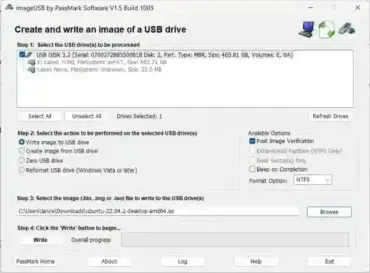
Here's how to write a compatible raw disk-image file to USB using Win32 Disk Imager:
- Download Win32 Disk Imager as a zipped file.
- Extract (Unzip) the contents to a folder on your desktop.
- From within the extracted folder, right-click the Win32DiskImager.exe file and select "Run as Administrator."
- Once the program is running:
- Browse to a compatible raw disk-image file, such as an IMG file. Use an ISO only if its publisher documents it for direct raw writing.
- Select your destination device.
- Click Write.
- Upon completion, reboot your computer from the USB drive to ensure it works as intended.

In this example, the ISO Image Writer was used to put a Rescatux Live ISO on a USB flash drive. Booting depends on whether the image supports direct raw writing and the target computer's firmware. Reboot the computer, set your BIOS or UEFI to boot from a USB drive, and boot from the Live USB.
Win32 Disk Imager Alternatives
While Win32 Disk Imager is a powerful and lightweight tool for writing disk images to USB drives, similar applications like Etcher can provide a more user-friendly experience and additional features. For example, Etcher supports multiple operating systems, including Windows, macOS, and Linux, making it a more versatile option for users who work across different platforms. In contrast, Win32 Disk Imager is limited to Windows.
Another key difference lies in ease of use. Etcher features a modern, intuitive interface designed for beginners, allowing users to flash images to USB drives in just a few clicks. Win32 Disk Imager also includes a Read function for saving a removable device as a raw image file, which can later be written to another device. It does not clone directly from one physical drive to another, and its older interface may require more care when selecting the source or destination.
Both tools include important safety features, such as file verification to ensure data integrity. However, Etcher also offers a built-in safeguard against overwriting system drives, a useful feature for less experienced users. Meanwhile, Win32 Disk Imager stands out for its portable version, which can run without installation, making it a convenient choice for on-the-go use.
Ultimately, your choice between Win32 Disk Imager and alternatives like Etcher depends on your specific needs. If you prioritize simplicity and cross-platform support, Etcher is an excellent option. If you need to read a removable drive into an image file or run a ZIP build without a conventional installation, Win32 Disk Imager may be a better fit. It does not clone directly between physical drives.
Comparison: Win32 Disk Imager vs. Etcher
| Feature | Win32 Disk Imager | Etcher |
|---|---|---|
| Open Source | Yes | Yes |
| Supported OS | Windows | Windows, macOS, Linux |
| Write Verification | Yes | Yes |
| Ease of Use | Moderate | Beginner-Friendly |
If you need a graphical tool for writing compatible OS images to USB or SD media, see our balenaEtcher review. For physical drive-to-drive cloning, choose a dedicated cloning utility instead.