Remove Empty Directories - RED
RED (Remove Empty Directories) is a small Windows utility that scans selected folders and drives for empty directories, then lets you remove the ones you no longer need. It can search nested folders, preview the results, and create a log of the cleanup operation. The program is distributed as a portable executable and is useful for tidying up directory structures left behind by old projects, installers, or file-management tasks.
RED: Find and Remove Empty Folders
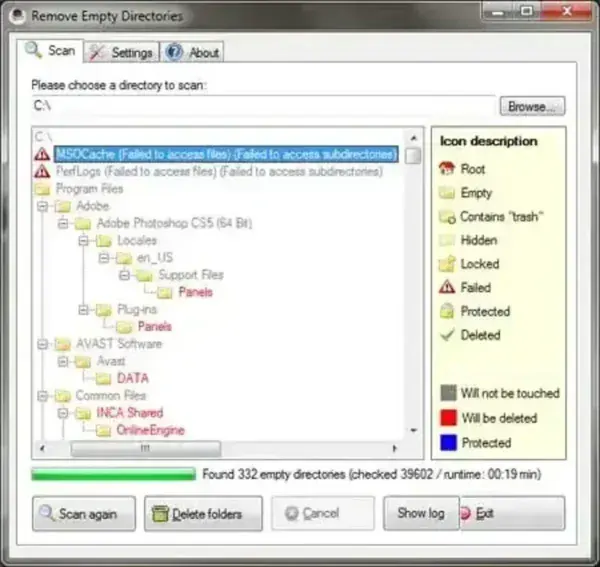
Empty folders can accumulate after software is uninstalled, archives are extracted, or files are moved between locations. RED scans a selected directory tree and lists folders that appear to contain no files or subfolders. You can review the list before confirming which directories to remove.
Folder Scanning and Cleanup Features
- Recursive scanning: Search a selected folder or drive and inspect nested directories.
- Result preview: Review the folders identified as empty before deleting them.
- Selective removal: Choose which detected directories to remove rather than deleting every result automatically.
- Hidden-item options: Configure scanning behavior for hidden folders and other selected file types.
- Empty-file handling: The application includes options for identifying or removing empty files, depending on the selected settings.
- Cleanup logs: Record information about the scan and removal operation for later review.
- Command-line support: Automate supported scanning and cleanup tasks using the program's command-line options.
- Portable executable: Run from a folder or USB drive without a conventional installation.
- Small footprint: The original package is approximately 180 KB when extracted.
RED can only judge whether a directory appears empty based on the items it can see and the selected scan options. Some applications use empty-looking folders as placeholders, mount points, or part of a directory structure that another program expects. Do not assume every empty folder is useless.
Scan and Remove Empty Directories
- Download RED from the developer's project page and extract the archive.
- Launch the executable from a local folder or USB drive.
- Select the folder or drive you want to scan. Avoid starting with the entire system drive.
- Review the scan options, especially settings for hidden folders and empty files.
- Start the scan and wait for the list of empty directories to appear.
- Review the full paths and deselect folders that belong to applications, backups, or projects you still use.
- Confirm the cleanup and review the log afterward.
For an extra precaution, move questionable folders to a temporary holding location instead of deleting them immediately. If a program later reports a missing folder, you can restore it. Do not run automated cleanup against Windows, Program Files, ProgramData, or application profile folders unless you understand the directory structure.
Portable Use and Compatibility
RED is distributed as a standalone Windows utility and can be carried on a USB drive. The original project lists Windows XP and later, but current Windows 10 and 11 compatibility has not been independently verified. Test the program on a non-critical folder before using it for a large cleanup. Portable operation does not guarantee that Windows or other software leaves no recent-file or activity records on the host computer.
RED Specifications
- Application: RED (Remove Empty Directories)
- Developer: Jonas John
- Version: The project page does not clearly identify a current release number
- License: Open source
- Platform: Windows XP and later listed by the developer; current Windows 10/11 compatibility should be tested
- Primary functions: Recursive empty-folder scanning, preview, selective deletion, logging, and command-line operation
- Additional options: Hidden-folder and empty-file handling
- Deployment: Portable executable, approximately 180 KB extracted
- Editor's Rating: ★★★★☆ (4/5)
- Official project page: RED - Remove Empty Directories
- Download: RED portable download
Frequently Asked Questions
Does RED scan nested folders?
Yes. It can recursively scan a selected directory tree and list empty directories found below the starting folder.
Can I review folders before deleting them?
Yes. RED displays the folders it identifies so you can review and deselect entries before confirming the cleanup.
Is it safe to delete every folder RED finds?
Not automatically. Some applications use empty folders as placeholders or expect a particular directory structure. Review the full paths and avoid deleting folders used by Windows or installed applications.
Can RED run from a USB drive?
Yes. It is distributed as a portable executable that can be launched from a folder or removable drive without a conventional installation.
Does RED remove empty files as well as empty folders?
The application includes options for handling empty files. Review the selected settings before running a cleanup so you do not remove files you intended to keep.
Does RED work on Windows 11?
The developer's original compatibility information lists Windows XP and later, but current Windows 11 support is not independently verified. Test it on a non-critical folder first.
Is RED Still Worth Using?
RED provides a straightforward way to locate empty directories across nested folder structures, review them, and remove selected entries. Its portable size and cleanup log make it convenient for occasional file maintenance. The important step is reviewing the results: an empty directory is not necessarily an unnecessary directory. Use RED on user folders and project directories first, keep a backup of important data, and avoid unattended cleanup of system locations.