SpaceMonger - Find Lost Disk Space
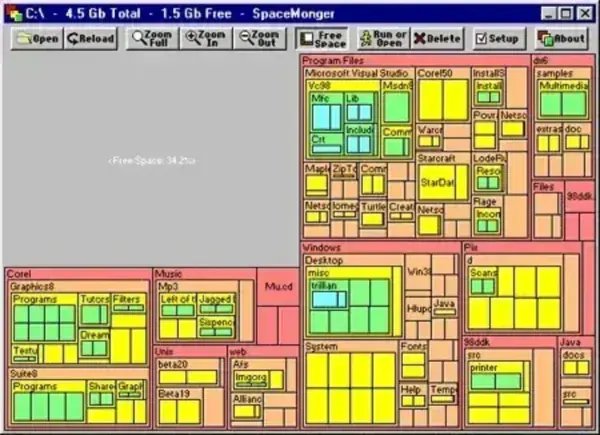
SpaceMonger 1.4 is a small Windows disk space analyzer that displays folder and file sizes as an interactive treemap. Large rectangles represent items that consume more storage, making it easier to locate oversized folders, forgotten downloads, and large media files. The freeware 1.4 release is a legacy build from the Windows XP era; newer SpaceMonger editions are commercial, and current compatibility of the old portable version is not guaranteed.
SpaceMonger: Visualize Disk Space with a Treemap
SpaceMonger scans a selected drive or folder and builds a visual map of its contents. You can zoom into a folder to inspect its subfolders and files, then use the display to identify which items account for the most disk usage. This is often quicker than opening folders one at a time in File Explorer.
How the Disk Map Works
- Treemap display: Represent folders and files as nested rectangles sized according to their storage usage.
- Zoom and navigation: Select a large folder to examine the items inside it.
- Large-file discovery: Quickly locate folders, archives, videos, and other files that occupy substantial space.
- Direct file operations: The interface allows selected files to be deleted from the map.
- Portable executable: Version 1.4 can be extracted and run from a folder or USB drive without a conventional installation.
- Small footprint: The archived freeware package is approximately 220 KB.
SpaceMonger reports file and folder sizes; it does not determine whether a file is safe to delete or whether Windows or an application still needs it. A large folder may contain system components, application data, backups, or files used by another program. Treat the treemap as a way to find candidates for review, not as an automatic cleanup recommendation.
Find Large Folders and Files
- Download SpaceMonger 1.4 and extract the ZIP package to a folder.
- Launch the executable and choose the drive or folder you want to analyze.
- Wait for the scan to complete and the treemap to appear.
- Look for large rectangles and select them to zoom into the corresponding folder.
- Use the folder and file names to identify what is consuming space.
- Open unfamiliar items in File Explorer and confirm their purpose before deleting or moving anything.
- Rescan the drive after making changes to see how the storage map has changed.
For a safer cleanup, move personal files to another drive or make a backup before deleting them. Avoid removing files from Windows, Program Files, ProgramData, or application profile folders unless you know exactly what they are and have a recovery plan.
Portable Use and Legacy Compatibility
SpaceMonger 1.4 is a standalone ZIP package that can be carried on a USB drive. Extract the archive and run the executable. The original freeware edition is no longer developed, and the developer's version 1.x page is available only through the Internet Archive. Archived compatibility listings cover older Windows versions, but reliable operation on Windows 10 and 11 has not been verified.
Newer SpaceMonger versions are commercial and have a different feature set. This article covers the historical freeware 1.4 release, not the current paid product. If you need a disk analyzer for a modern Windows PC, consider a maintained tool such as TreeSize Free or WinDirStat.
SpaceMonger Specifications
- Application: SpaceMonger
- Developer: Sixty-Five Software Inc.
- Freeware version: 1.4
- Release period: Legacy Windows XP-era release
- License: Freeware for version 1.4; newer versions are commercial
- Platform: Older Windows versions; current Windows 10/11 compatibility is not verified
- Primary function: Visual disk space analysis using an interactive treemap
- Deployment: Portable ZIP package, approximately 220 KB
- Development status: Freeware 1.4 discontinued
- Editor's Rating: ★★★★☆ (4/5) for its original lightweight disk-visualization design
- Archived project page: SpaceMonger 1.x at the Internet Archive
- Download: SpaceMonger 1.4 ZIP (legacy executable; scan before use)
- Modern alternative: WinDirStat
Frequently Asked Questions
What does SpaceMonger show?
It displays a treemap of file and folder sizes. Larger rectangles represent items that use more storage, helping you find where disk space is being consumed.
Can SpaceMonger delete files?
Yes. The interface includes file deletion, but it does not know whether a selected file is safe to remove. Check the item's purpose and make a backup before deleting anything important.
Is SpaceMonger 1.4 portable?
Yes. The freeware version is distributed as a small ZIP package that can be extracted and launched from a folder or USB drive.
Does SpaceMonger 1.4 work on Windows 11?
Current Windows 11 compatibility is not verified. The freeware release is old, so test it on a non-critical system. Use a maintained disk analyzer for dependable current Windows support.
Is SpaceMonger 1.4 still free?
Version 1.4 is the last known freeware release. Newer SpaceMonger versions are commercial and should not be confused with this archived edition.
Is SpaceMonger Still Worth Using?
SpaceMonger 1.4 introduced a simple, intuitive way to see which files and folders were using the most disk space. Its small portable package and zoomable treemap made it convenient for older Windows systems. The freeware edition is no longer maintained, and current compatibility is uncertain, so use it as a legacy disk-visualization tool rather than a modern cleanup solution. For current systems, choose a maintained disk analyzer and review files carefully before removing them.