DiskDigger: Recover Deleted Files from Windows Drives
DiskDigger is a file recovery utility that can scan hard drives, USB flash drives, and memory cards for deleted files. It combines a file-system-aware scan with a deeper free-space scan that searches for recognizable file data. The Windows program is distributed as a single executable, so it can be run without a conventional installation. Scanning and previewing recoverable files are free, but saving recovered files displays license reminders, and commercial use requires a commercial license.
DiskDigger: Recover Deleted Files from Windows Drives
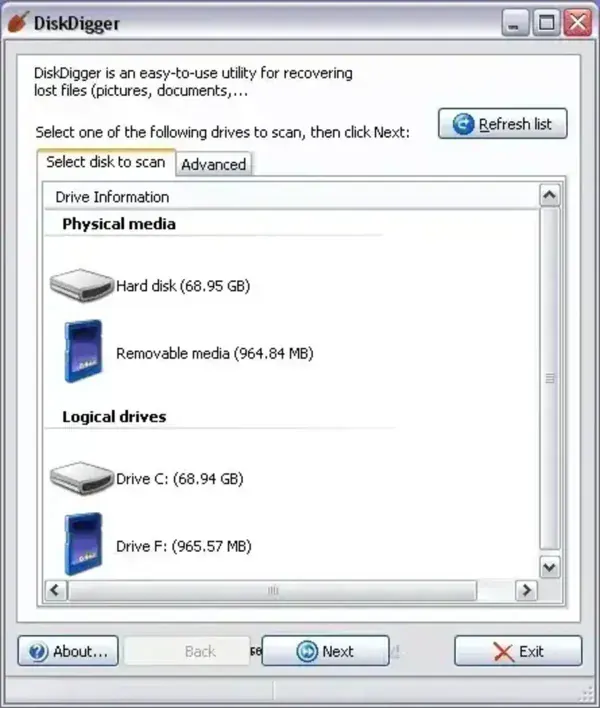
When a file is deleted, the operating system may remove its directory entry while leaving some of its data on the storage device. DiskDigger searches for information that may still be recoverable. It can be useful when you accidentally delete photos, documents, videos, or other files from a hard drive, USB drive, or memory card.
How DiskDigger Scans for Lost Files
- File-system scan: Searches supported file systems for deleted entries and their associated data. This method can retain original file names and folder information when the required metadata is still available.
- Free-space scan: Searches storage sectors for recognizable file signatures. This can find files when directory information is missing, although recovered results may have generic names or incomplete folder details.
- Preview and filtering: Lets you inspect many recoverable files and filter or sort results before choosing what to save.
- Removable storage: Can scan USB flash drives, memory cards, and other storage devices that the computer can access.
- Multiple file types: The developer lists support for common photos, videos, audio, documents, archives, and other file formats.
Recovery is never guaranteed. If the operating system has reused the space occupied by a deleted file, some or all of its contents may be gone. A free-space scan can also have difficulty reconstructing fragmented files. Stop writing new data to the affected drive as soon as possible to reduce the chance of overwriting recoverable information.
How to Recover Files More Safely
- Stop saving files or installing programs on the drive where the deleted data was stored.
- Download DiskDigger from the developer's website and run the executable. The Windows download does not require a conventional installation.
- Select the disk or removable device that contained the missing files and choose the appropriate scan method.
- Review the results and preview files where possible. Search by file type, name, or other available details.
- Save recovered files to a different physical drive or storage device, not back to the drive being scanned.
- Open the recovered files to confirm that they are complete and usable.
Saving recovered data to the original device can overwrite other deleted files that have not yet been recovered. For valuable or irreplaceable data, consider creating a sector-by-sector image of the device or consulting a professional recovery service before attempting repairs.
Free Use, Licensing, and Supported Systems
DiskDigger can be downloaded, used to scan a drive, and used to preview recoverable files without purchasing a license. When you save recovered files, the Windows program displays reminders to purchase a personal license. The developer says you can continue without a key, but the reminder appears for each file being recovered. Commercial use requires a commercial license, so the free personal-use experience should not be confused with unrestricted business use.
The current desktop download page lists version 2.7.73.4643 for Windows, Linux, and macOS, with separate Windows builds for 64-bit, ARM64, and 32-bit systems. The Windows program is a single executable. DiskDigger for Android is a separate app; the desktop version cannot recover data directly from an Android phone connected over USB. For a removable microSD card, remove the card and scan it using a card reader.
DiskDigger Specifications | Official Site | Download
- Developer: Dmitry Brant
- Current listed version: 2.7.73.4643
- License: Free scanning and preview; personal license reminders when saving; commercial use requires a commercial license
- Platforms: Windows, Linux, and macOS desktop builds
- Windows architectures: 64-bit, ARM64, and 32-bit
- Deployment: Single executable; no conventional installation required for Windows
- Recovery methods: File-system-aware recovery and free-space scanning
- Supported storage: Hard drives, USB flash drives, memory cards, and other readable media
- Editor's Rating: ★★★★☆ (4/5)
- Official download: Download DiskDigger
- Features: DiskDigger recovery features
- Help: Official DiskDigger FAQ
Is DiskDigger Worth Trying?
DiskDigger offers a useful combination of file-system recovery, deeper scanning, and file previews in a compact program that does not need a traditional Windows installation. Its main limitations are that recovery depends on whether the deleted data has been overwritten, and saving files in the Windows edition comes with repeated license reminders. It is worth considering for personal recovery attempts, provided you stop using the affected drive and save recovered files somewhere else.