ImageUSB is a free and portable USB imaging utility for Windows that can create exact, bit-level copies of USB flash drives and other removable storage devices. It can create image files from removable media, write those images back to drives, and duplicate USB devices for backup, recovery, testing, or deployment purposes.
Because ImageUSB works at the disk level, it can preserve information that ordinary file-copy utilities do not, including boot information, partitions, unused space, and other low-level data. This makes it particularly useful when working with bootable USB drives, recovery media, forensic images, and removable storage that needs to be duplicated accurately.
ImageUSB | Free USB Imaging and Cloning Tool
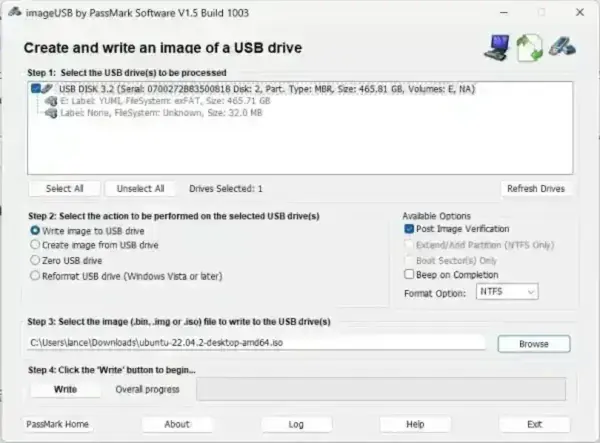
ImageUSB is a small Windows utility from PassMark Software designed for creating and writing USB drive images. Unlike a normal file-copy operation, it can make a complete bit-level representation of a removable drive.
This makes it useful when you need to preserve the exact structure of a USB device rather than simply copy the files stored on it.
For example, an image can contain the boot sector, partition information, operating system files, applications, configuration data, and unused or slack space. This is particularly important when duplicating bootable media where copying the visible files alone may not produce a bootable copy.
The application is also portable. You can download the ZIP archive, extract it, and launch ImageUSB.exe without going through a traditional installation process. :contentReference[oaicite:2]{index=2}
What Can ImageUSB Do?
ImageUSB provides several operations for working with removable drives and disk images. Depending on the task, you can create an image from a USB drive, write an existing image to one or more drives, or perform other low-level storage operations.
Some of its primary capabilities include:
- Create USB Drive Images: Read the contents of a USB flash drive and save it as an image for backup or later restoration.
- Write Images to USB Drives: Restore a previously created image or write a compatible disk image directly to removable media.
- Bit-Level Duplication: Create exact copies of USB media rather than simply copying individual files.
- Bootable Media Support: Preserve boot information and partition structures when imaging bootable USB devices.
- Multiple Drive Imaging: Write an image concurrently to multiple USB flash drives for faster duplication.
- Image Verification: Verify written data to help confirm that the destination matches the source image.
- ISO and IMG Support: Work with common disk image formats, including IMG files and USB-oriented ISO operations.
- Portable Operation: Extract the program and run it directly without a conventional installation.
- Drive Zeroing: Zero an entire USB drive or selected low-level disk structures when required.
- USB Drive Recovery Operations: Some low-level formatting and recovery-related functions can help reclaim storage on problematic removable drives.
PassMark specifically describes the program as capable of creating exact bit-level copies and writing an image concurrently to multiple USB flash drives. It can also preserve unused and slack space along with the Master Boot Record. :contentReference[oaicite:3]{index=3}
USB Imaging vs. Normal File Copying
A normal file-copy operation transfers accessible files and folders from one location to another. That is often sufficient for documents, photographs, videos, and other ordinary data.
USB imaging is different.
When an entire removable drive is imaged, the process works with the underlying storage rather than only the visible files. This allows information such as partition layouts and boot sectors to be preserved.
For example, copying the files from a bootable Linux USB drive to another flash drive does not necessarily recreate the boot structure. A sector-level image, on the other hand, is designed to reproduce the source drive much more accurately.
This makes ImageUSB particularly useful when the goal is to reproduce a USB drive rather than simply transfer its contents.
Common Uses for ImageUSB
There are many situations where an exact removable-drive image can be useful.
- Backup Bootable USB Drives: Preserve a working bootable drive before making changes to it.
- Duplicate Installation Media: Create multiple copies of a prepared USB device.
- Linux Live USB Backups: Preserve a customized Linux environment for later restoration.
- Windows Installation Media: Duplicate prepared Windows installation or recovery media.
- Recovery Drives: Keep backup copies of important recovery and diagnostic devices.
- Technician Toolkits: Maintain reproducible USB drives containing diagnostic and repair utilities.
- Testing: Create a backup before experimenting with bootable media or storage configurations.
- Mass Deployment: Write the same prepared image to multiple USB drives.
- Forensic and Archival Work: Preserve removable media at a low level for later analysis or reference.
How to Create a USB Image
Creating a backup image is relatively straightforward, although care is required whenever working with physical disks.
- Download ImageUSB: Download the ZIP archive from the official PassMark website.
- Extract the Program: Extract the contents of the ZIP file to a folder on your computer or portable drive.
- Launch ImageUSB: Run ImageUSB.exe.
- Select the Source Drive: Carefully select the USB device you want to back up.
- Choose the Imaging Operation: Select the appropriate option for creating an image from the selected USB device.
- Choose an Image File: Specify where the resulting image should be saved.
- Start the Process: Begin the imaging operation and allow it to complete.
- Verify the Result: If available for the operation, use verification to confirm that the image was created correctly.
The resulting image can then be stored on another hard drive, SSD, network location, or other storage device for later use.
How to Restore an Image to a USB Drive
A previously created image can be written back to a compatible USB drive when you need to restore the original contents.
- Connect the destination USB drive.
- Launch ImageUSB.
- Verify the correct destination device is selected.
- Select the option for writing an image to the USB drive.
- Browse to the previously created image.
- Confirm the destination drive.
- Start the write operation.
- Wait for the operation and any verification process to finish.
Important: Writing a disk image is a destructive operation. Existing information on the destination drive can be overwritten. Always double-check the selected device before proceeding.
Clone Multiple USB Drives
One of the more useful features for technicians and administrators is the ability to write an image to multiple USB flash drives concurrently.
This can significantly reduce the amount of time required to prepare a group of identical devices. Instead of manually preparing each flash drive one at a time, the same source image can be written to multiple connected drives.
This can be useful for:
- Preparing classroom computers or training media.
- Creating multiple identical recovery drives.
- Deploying standardized Linux USB environments.
- Preparing technician toolkits.
- Duplicating bootable installation media.
PassMark documents support for concurrent writing to multiple USB flash drives and has expanded the number of drives the software can recognize over its development history. :contentReference[oaicite:4]{index=4}
ImageUSB and YUMI Py USB Cloning
If your primary goal is to make a complete backup or direct clone of a prepared multiboot USB drive, another option worth considering is YUMI Py.
YUMI Py includes a dedicated Backup/Restore/Clone feature that operates at the physical disk level. Its Backup option creates a complete image of a prepared drive, Restore writes an image back to a drive, and Clone copies one physical drive directly to another without creating an intermediate image file. It also includes an optional verification pass that compares the copied data byte-for-byte. :contentReference[oaicite:5]{index=5}
This makes YUMI Py particularly interesting if the USB drive you are working with is already configured as a YUMI multiboot device and you want to preserve or reproduce the entire setup.
For a general-purpose USB imaging utility, however, ImageUSB remains useful because it is specifically designed around removable-drive imaging and duplication.
ImageUSB vs. YUMI Py
Both applications can be useful for duplicating USB drives, but they approach the task from different directions.
| Feature | ImageUSB | YUMI Py |
|---|---|---|
| Primary Purpose | USB imaging and duplication | Multiboot USB creation with backup and cloning features |
| Create Drive Image | Yes | Yes |
| Restore Image | Yes | Yes |
| Direct Drive-to-Drive Clone | Imaging-focused workflow | Yes |
| Multiple USB Duplication | Yes | Not the primary focus |
| Multiboot USB Creation | No | Yes |
| Portable | Yes | Yes |
| Operating Systems | Windows | Windows and Linux |
| Best For | USB imaging and mass duplication | Multiboot drives and complete USB backup, restore, and cloning |
Important Considerations Before Cloning a USB Drive
Because these programs work with physical storage devices, extra care should be taken before starting an imaging or cloning operation.
- Check the Drive Selection: Selecting the wrong destination can result in permanent data loss.
- Back Up Important Data: Do not rely on an untested image as your only backup.
- Use an Appropriate Destination: A destination drive generally needs sufficient capacity for the image being written.
- Do Not Interrupt the Operation: Disconnecting a drive during imaging or writing can leave the destination in an unusable state.
- Safely Remove USB Drives: Allow all read/write operations to finish before disconnecting removable media.
- Verify Critical Images: Verification is worthwhile when the image will be used as an important backup or deployment source.
PassMark also warns that the destination should have appropriate storage capacity. When an image is written to a larger drive, the resulting partition or usable space may not automatically occupy the entire device, depending on the image and configuration. :contentReference[oaicite:6]{index=6}
Portable USB Imaging Tool for Technicians
One of the advantages of keeping ImageUSB in a portable software toolkit is that it can be carried alongside other USB maintenance and recovery utilities.
A technician could keep the application on a flash drive together with disk diagnostics, partition management utilities, bootable recovery environments, and other troubleshooting tools.
Since the program can be extracted and launched directly, there is no need to perform a conventional installation simply to create or restore an image. :contentReference[oaicite:7]{index=7}
This makes it a practical addition to a portable Windows toolkit.
ImageUSB Specifications | Official Site | Download
- Developer: PassMark Software
- Application: ImageUSB
- Current Version: 1.5.1007
- Download Size: Approximately 2.3 MB
- License: Free utility
- Portability: Yes
- Supported Operating Systems: Windows 7, Windows 8, Windows 10, and Windows 11
- Category: USB Imaging / Disk Utility
- Developer Website: PassMark ImageUSB Project Page
- Download: ImageUSB ZIP Download
The official project page currently lists ImageUSB version 1.5.1007 and describes it as a free utility for creating and writing USB images. :contentReference[oaicite:8]{index=8}
Frequently Asked Questions
What is ImageUSB used for?
ImageUSB is used to create, restore, and duplicate USB drive images. It is particularly useful for backing up bootable USB drives and creating multiple identical copies of removable media.
Is ImageUSB portable?
Yes. ImageUSB is distributed as a ZIP archive that can be extracted and run without a traditional installation.
Can ImageUSB clone a bootable USB drive?
Yes. Its bit-level imaging capabilities are designed to preserve the underlying contents of removable media, including boot information and partition structures.
Can ImageUSB copy multiple USB drives at once?
Yes. ImageUSB supports writing an image concurrently to multiple USB flash drives, making it useful for mass duplication. :contentReference[oaicite:9]{index=9}
Does ImageUSB create an image file?
Yes. The application can create an image of a USB flash drive that can later be written back to removable media.
Can ImageUSB restore a USB drive?
Yes. A previously created image can be written back to a compatible USB drive.
Can YUMI Py clone a USB drive?
Yes. YUMI Py includes Backup, Restore, and Clone operations. Its Clone function copies one physical drive directly to another, while Backup and Restore use a complete image file. :contentReference[oaicite:10]{index=10}
Is ImageUSB free?
Yes. PassMark distributes ImageUSB as a free utility.
Does ImageUSB work with Windows 11?
Yes. The current official system requirements list Windows 11 along with Windows 7, 8, and 10. :contentReference[oaicite:11]{index=11}
Final Thoughts
ImageUSB is a useful free utility for anyone who needs to work with USB drives at the disk-image level. Rather than simply copying files, it can create and write bit-level images that preserve the underlying structure of removable media.
Its ability to create USB images, restore them, verify operations, and write images to multiple drives makes it especially useful for technicians, developers, system administrators, and anyone maintaining bootable USB media.
The portable nature of the application is another advantage. You can keep the program on a USB toolkit and launch it when needed without installing a large application on every computer. If the goal is instead to maintain and reproduce a YUMI multiboot drive, YUMI Py is also worth considering because it includes dedicated Backup, Restore, and Clone functionality.
For a lightweight, portable Windows utility dedicated to USB imaging and duplication, ImageUSB remains a practical tool to keep in a portable software or technician toolkit.