
MobaLiveCD is a Free Portable Live CD Emulator that utilizes a software front end for Qemu to enable you to Run Linux on Windows. It allows you to boot and run Linux Live CDs and other bootable ISO files directly from within Windows without rebooting your system. Even better, the entire setup can be stored and launched from a portable USB flash drive, making it ideal for testing, diagnostics, and demonstrations on the go.
Portable Live CD Emulator MobaLiveCD
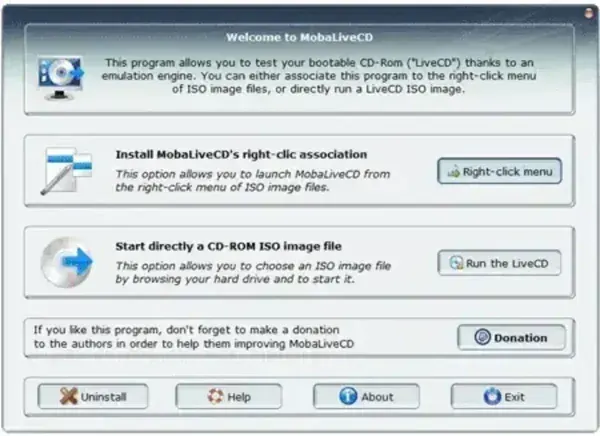
MobaLiveCD bridges the gap between traditional virtualization software and full dual boot setups. Instead of installing a hypervisor or rebooting into a different operating system, this lightweight emulator lets you quickly load and explore Linux environments from ISO files while staying inside Windows.
What is MobaLiveCD and How is it useful?
MobaLiveCD is a free and portable software tool that allows users to run Linux live CDs from ISO files on their Windows computer without the need to reboot or install Linux on the system hard drive. A Live CD or Live USB is a bootable CD or USB containing an operating system that can be run directly from external media.
This operating system emulator works much like a simplified, portable alternative to VirtualBox, enabling users to Run Linux on Windows for testing, troubleshooting, or evaluation purposes. It is especially useful when you want to verify that a Linux ISO boots correctly before creating a bootable USB or installing it on physical hardware.
Here are some of its most notable features and benefits:
- No Installation Required: Does not require installation on your Windows system. The emulator runs directly from the executable file.
- Run Linux Live CDs from ISO files: Boot and test Linux distributions directly from ISO images without modifying your hard drive.
- Linux Testing and Evaluation without Installation: Ideal for users who want to experiment with Linux distributions before committing to a full installation.
- Convenience: Eliminates the need to burn CDs or repeatedly create bootable USB drives just to test ISOs.
- USB Portability: Can be stored and executed entirely from a USB flash drive alongside your ISO files.
Common Use Cases
MobaLiveCD is frequently used by:
- Linux beginners who want to explore distributions safely
- System administrators testing rescue or recovery ISOs
- Developers validating bootable ISO builds
- IT technicians demonstrating Linux environments on Windows PCs
- USB toolkits that include diagnostics and live operating systems
To use this free emulation software, simply store the MobaLive.exe file along with your Linux Live CDs or other bootable ISO images on your USB drive. Launch MobaLiveCD, select the ISO you wish to boot, and the alternate operating system will start in a window while Windows continues running in the background. This provides a fast and low risk way to verify ISO functionality before deployment.
Performance and Limitations
While MobaLiveCD is convenient and portable, it is intentionally minimal. The Qemu configuration is fixed, and advanced performance options are not exposed to the user. The Kqemu accelerator is not included, and Qemu launcher settings are not adjustable. As a result, some Linux ISOs may run slowly or fail to boot entirely.
For users who need near native performance, advanced hardware passthrough, or long term virtual machines, full virtualization platforms such as VirtualBox, VMware, or Proxmox are better suited. MobaLiveCD is best viewed as a quick testing and verification tool rather than a replacement for full virtual machines.
MobaLiveCD Specifications | Official Site | Download Link
- Authors Website: Project Page
- Developer: Mobatek
- License: Open Source
- Supported OS: Windows
- Application Type: Portable Live CD and ISO Emulator
- Downloading: You can find this operating system emulation software here: MobaLiveCD Download
Final Thoughts
MobaLiveCD remains a practical and lightweight solution for anyone who wants to quickly test Linux Live CDs or bootable ISO files without rebooting their Windows system. Its portability, simplicity, and zero installation requirement make it a valuable addition to any USB based toolkit.
Although it cannot match the speed or flexibility of full virtualization platforms, its ease of use and focus on ISO testing make it a reliable choice for quick Linux exploration, diagnostics, and boot validation tasks.